Peru · Remote (UTC-5) — full overlap with US Eastern
Oscar Daniel Navarro Cieza
Frontend & AI-Augmented Full-Stack Developer
Four years building web and mobile applications in production. My core is frontend — React, Next.js and TypeScript — and I take responsibility for backend, database and deployment when a small team needs it.
Most of my recent work puts language models inside products people actually use. I deploy and maintain all of it myself, and I deliberately left several of these running unattended for weeks to find out whether they would hold up.
Based in Peru, UTC-5. Remote only, available as an independent contractor.
Projects
TickerLens
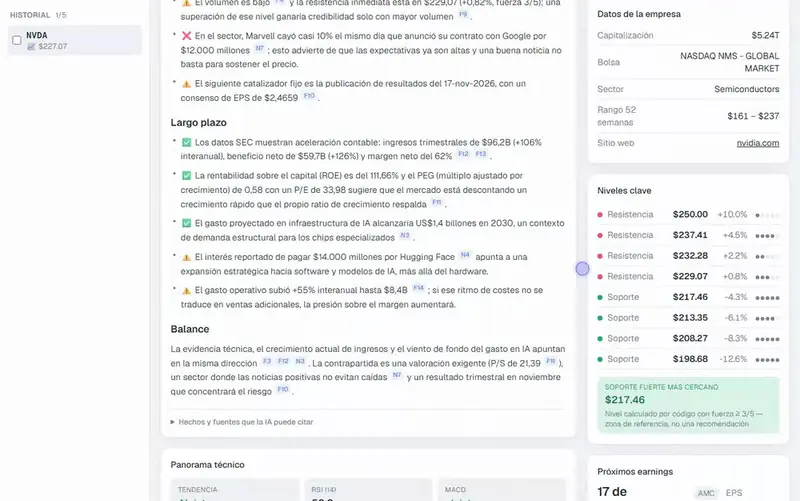
AI equity researchType a ticker, get a cited bull and bear case.
Every claim in the analysis links back to the source it came from. Retrieval runs over facts the application computes itself rather than over scraped text, with embeddings generated in-process and tokens streamed to the client as they are produced. Rate limiting is hardened against spoofed forwarded headers, and the app degrades gracefully when the database or the embedding model is unavailable.
Stack — TickerLens
- Next.js
- TypeScript
- Tailwind
- FastAPI
- Python
- PostgreSQL + pgvector
- Docker
- nginx
tvindicators
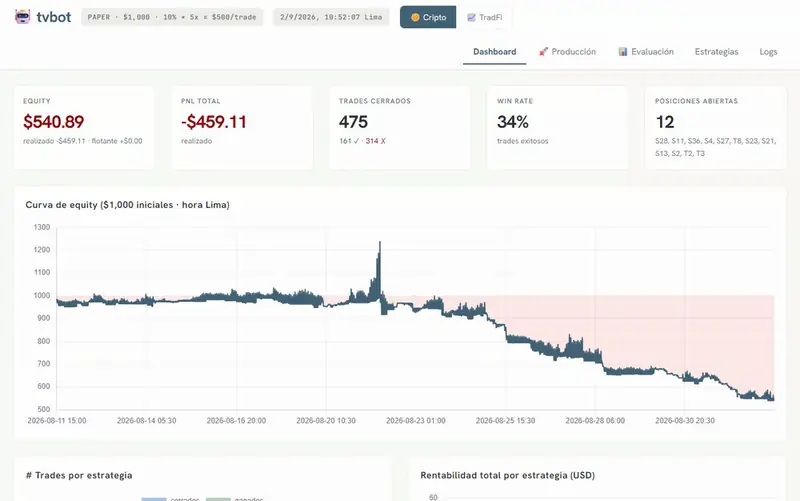
strategy validation engineTrading strategies reimplemented in Python and put through continuous paper trading to find out which ones survive contact with the live market.
The system exists to rule strategies out, not to make money: it measures each one’s live expectancy against its backtest and flags the ones that stop reproducing what they promised. Most failing is the expected result — a strategy that holds up outside its own backtest is the exception, and finding one means measuring the rest honestly. Over 40 strategies run against Binance perpetual futures, with a REST API exposing equity curves and the live-versus-backtest evaluation. A pre-push hook blocks any commit where the live signal path stops reproducing the backtest. Paper trading only — it has never traded real money, and its own documentation warns against reading the backtest Sharpe as a live expectation.
Stack — tvindicators
- Python
- ccxt
- SQLite
- FastAPI
- systemd
Estudia
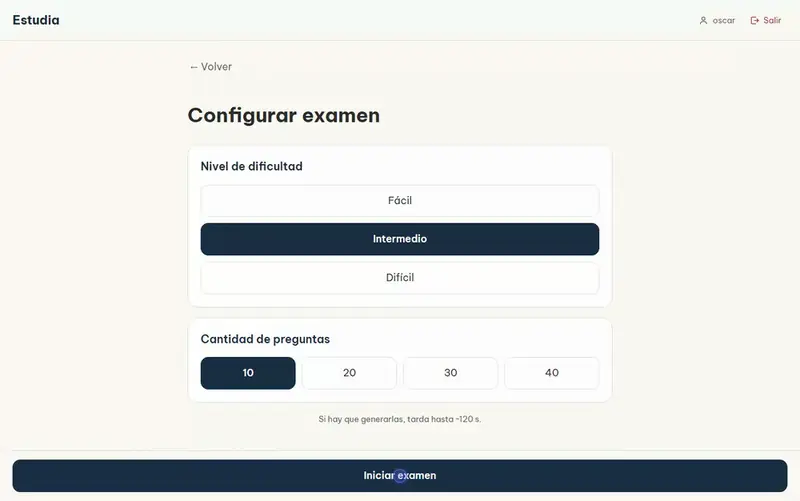
AI study companionPhotograph handwritten class notes, get a study summary and an auto-graded exam.
A three-stage pipeline takes the photographs through transcription, summary and question generation. It uses context-window-aware chunking rather than retrieval, deliberately: the product needs full-document coverage, not a relevant slice. Multi-user with authentication, installable as a progressive web app and as an Android app. 168 tests, and a security audit whose ten findings were all fixed with regression tests covering each one.
Stack — Estudia
- Python
- FastAPI
- SQLite
- PWA
- Android (TWA)
- Docker
momentum-investor
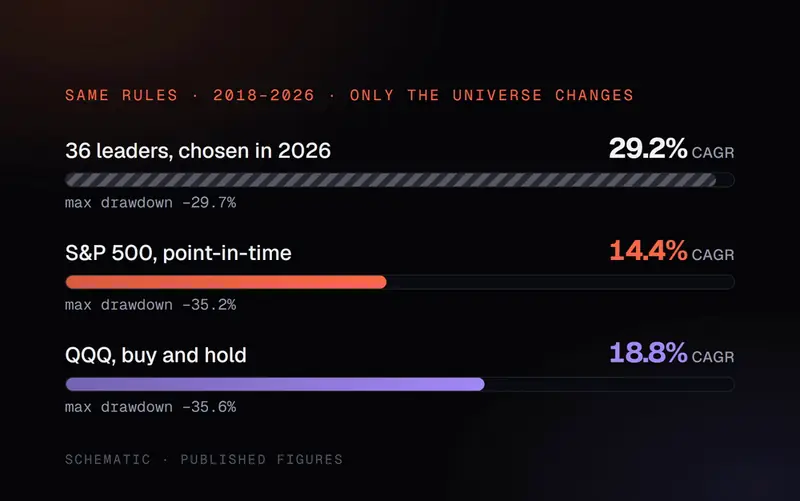
stock momentum auditA US-stock momentum robot, and the audit that showed its edge came from choosing the stock list with hindsight.
Same rules, engine, data and dates, run on two universes. On 36 market leaders chosen in 2026 the strategy returned 29.2% a year; on the stocks actually in the S&P 500 on each date, including the ones that later collapsed or were acquired, it returned 14.4% — below holding QQQ at 18.8%. Choosing the list with hindsight was worth 14.9 points of CAGR. The audit replays the robot’s real mechanics and changes only the universe. What survives is a regime filter on QQQ that does not beat it on return: it earns 2 to 4 points a year less, in exchange for a drawdown of about -30% instead of -49% to -53% through 2008. The robot ran on an Alpaca paper account, with idempotent orders and broker-side stops reconciled on every heartbeat. Moving to real money depended on the research, so it never happened.
Stack — momentum-investor
- Python
- pandas
- FastAPI
- SQLite
- Alpaca API
- Chart.js
- systemd
Exposure Dashboard
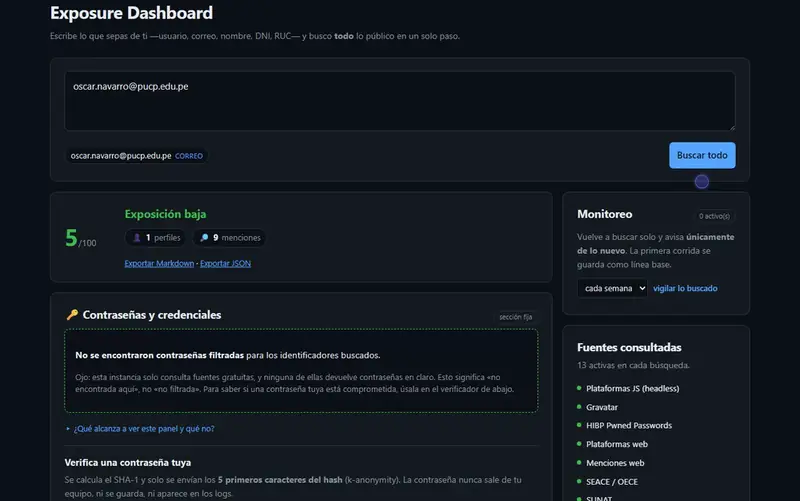
OSINT aggregationGive it a username, email or national ID and it reports public exposure with a confidence score and its reasoning.
Thirteen plugin-based collectors run in parallel with isolated failure handling, so one failing source never takes down a search. Identities are correlated across accounts by avatar perceptual hash, bio similarity and shared outbound links. Every redirect hop is validated against SSRF. 234 tests, running on a single vCPU.
Stack — Exposure Dashboard
- Python
- FastAPI
- Next.js
- SQLite
- Playwright
- Docker
Kepler
market-neutral trading systemA market-neutral crypto system that ran on real capital.
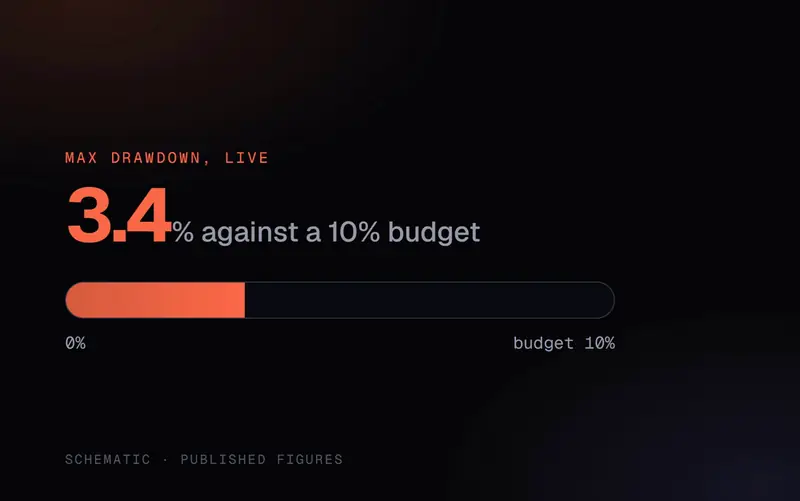
Seven uncorrelated alpha sleeves, leverage auto-sized to a maximum-drawdown budget, maker-only execution and a drawdown circuit breaker. Live maximum drawdown was 3.4% against a 10% budget across 18 days of live operation. Validation used walk-forward testing with purged out-of-sample data and embargo. Archived for business reasons rather than engineering ones: low-drawdown copy-trading at micro-capital produced no visible return without scale. It was a difficult decision, and I still consider it the correct one.
Stack — Kepler
- Python
- SQLite
- FastAPI
- Binance API
Mi Peso
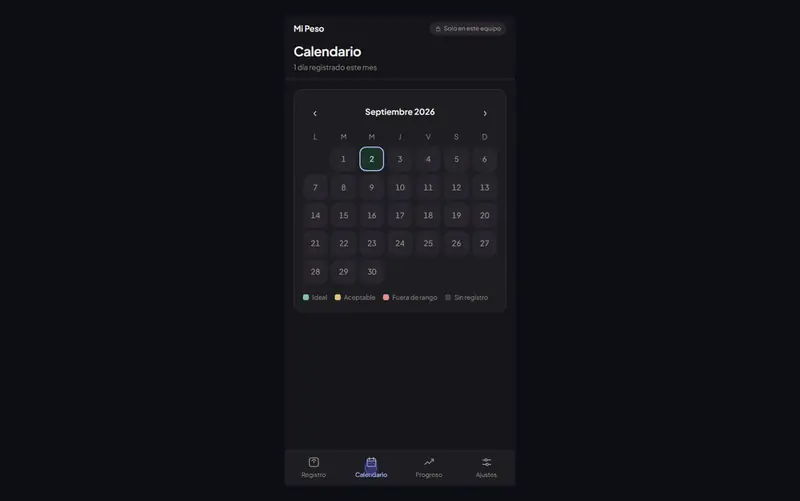
local-first weight trackerA weight tracker with no server and no account.
SQLite compiled to WebAssembly and persisted in the browser, with charts drawn by hand in SVG and no charting library. One codebase ships as a progressive web app and as an Android app. Its own SECURITY.md states the two honest limitations: the database is not encrypted on the device, and the published APK is signed with a debug key rather than a release key.
Stack — Mi Peso
- React 19
- TypeScript
- Vite
- SQLite/WebAssembly
- Capacitor
Oscilion
crypto strategy experimentA crypto trading system built to answer one question — is there an edge after real costs? — and closed when the answer was no.
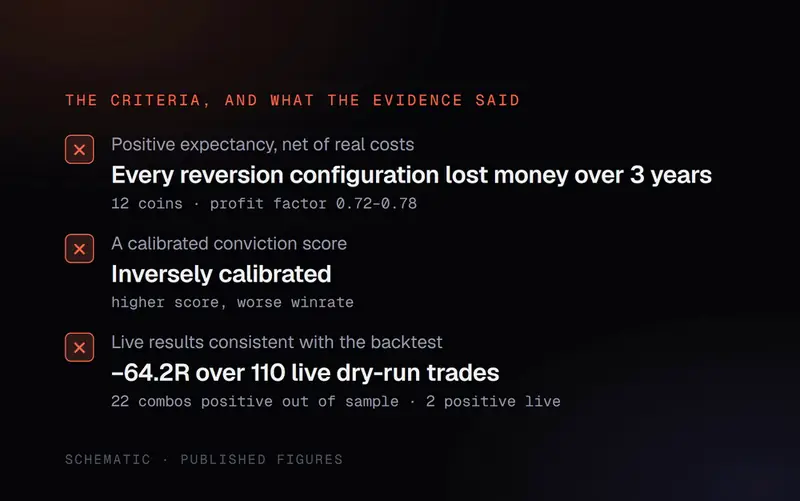
Its go/no-go criteria went into the first commit, before any signal or backtest code existed. The original range-reversion thesis failed them: over three years and 12 coins, net of costs, every configuration lost money, and its conviction score was inversely calibrated. Five directional strategies that had passed walk-forward and double out-of-sample checks were then run live in dry-run: 110 trades over 7.8 weeks returned -64.2R, and of 22 combinations positive out of sample, 2 were positive live. Closed on 3 August 2026 at v1.0, with no real capital ever traded. Its own conclusion is that the strategies have no edge. The signal code is shared by the backtest and the live monitor, so what was validated is what ran.
Stack — Oscilion
- Python
- pandas
- ccxt
- statsmodels
- SQLite
- FastAPI
- React + TypeScript
- systemd
Also built: a desktop video editor for multi-gigabyte recordings with packet-accurate cutting and hardware-accelerated export, and a catalyst alerting service that measures the actual abnormal price reaction to each alert it sends.
Experience
Frontend Engineer · Pairus Inc. (Canada, remote)
Jul 2025 – Jan 2026
Led the frontend of an AI dating product: personality questionnaire, embedding-based matching, real-time monitoring dashboards and Stripe payment interfaces.
Software Engineer (contract) · Belsitec
Jun 2023 – Present
Admission and student portals for a university operating in Peru, Florida and Mexico; a full web platform and an attendance app for a private school.
Frontend & Full-Stack Developer · Independent
2023 – Present
Reservation PWAs, self-manageable business sites with custom admin panels.
Technology Consultant (internship) · IBM Peru
Apr 2022 – Mar 2023
Web and mobile development for corporate clients; IBM Cloud services.
Technologies
- React
- Next.js
- TypeScript
- JavaScript
- Tailwind CSS
- Python
- FastAPI
- Node.js
- PostgreSQL
- SQLite
- Docker
- nginx
- Linux
- Git
- CI/CD
- LLM integration
- RAG
- Progressive Web Apps
- Capacitor
- WebAssembly